LOADING_
VocalUp — A Vocal Trainer in the Browser
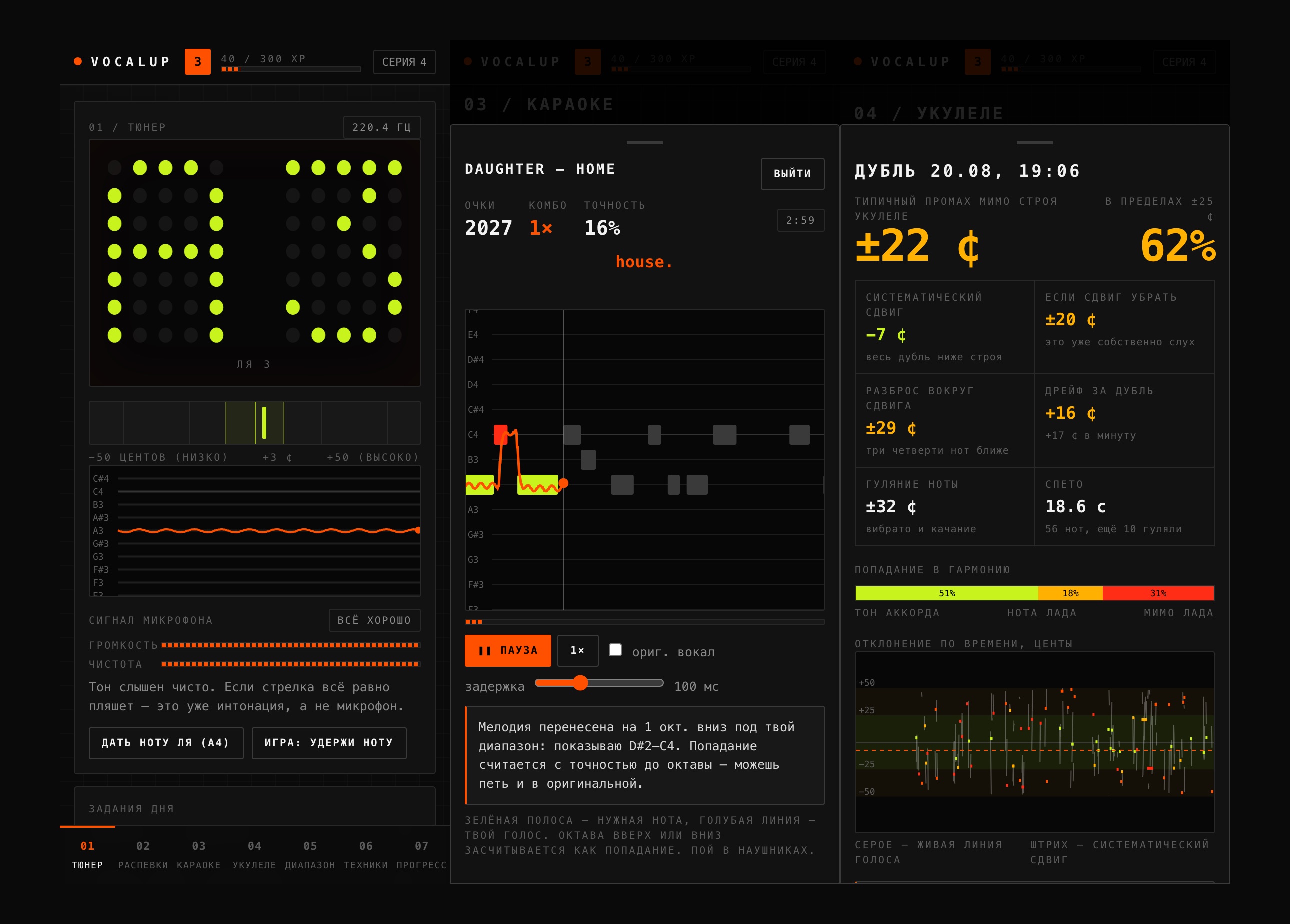
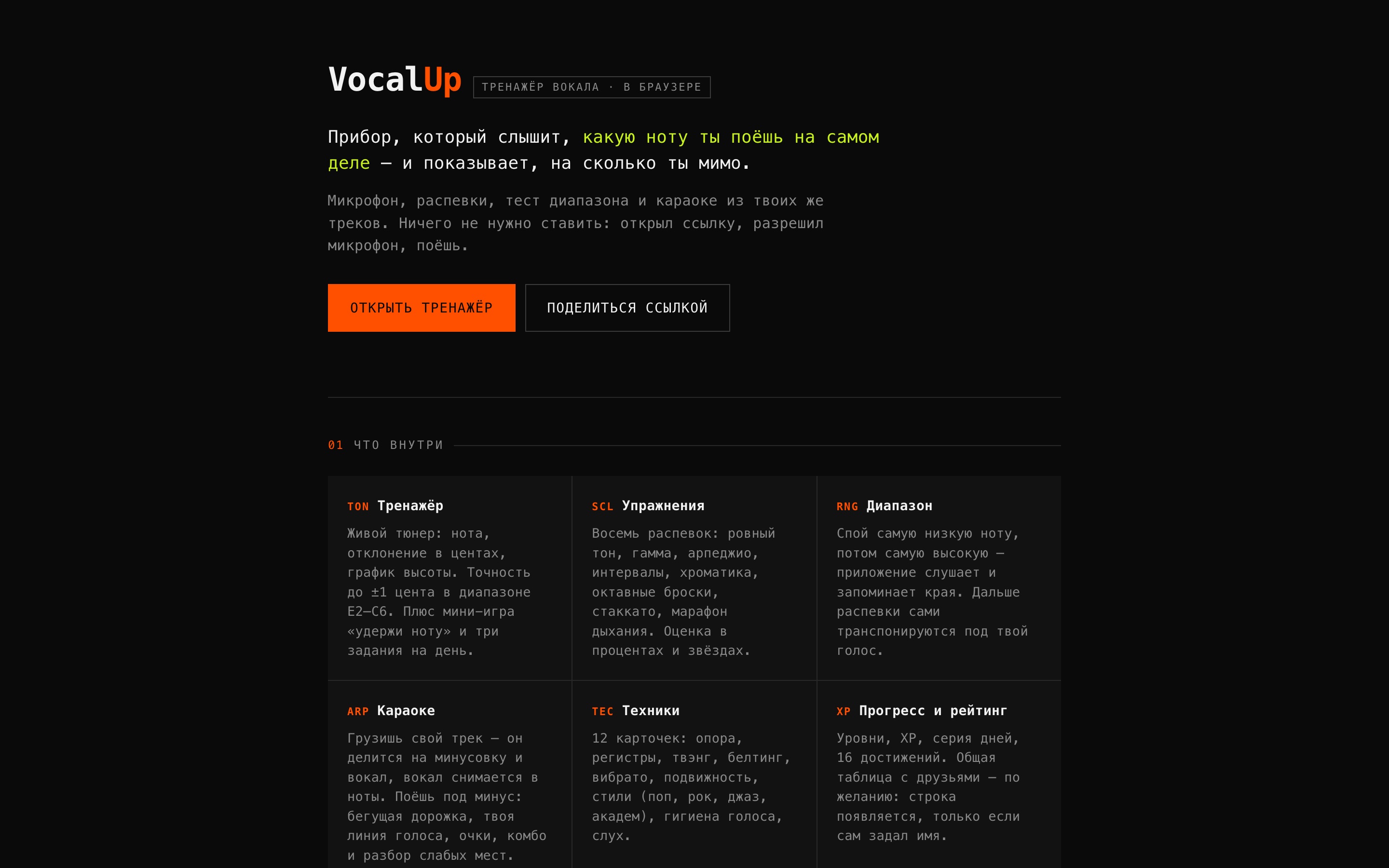
A web app that listens through the mic and shows in real time whether you hit the note. Warm-ups, a range test, karaoke with your own tracks and a ukulele singing report. No install, works offline, on phone and laptop. AudioWorklet + Essentia WASM · Python DSP · Vercel + Redis — product, design, front end, audio DSP and back end, solo.
SPECIFICATIONS
- STATUSactive
- VISIBILITYpublic
- ROLEproduct
- ROLEdesigner
- ROLEfull-stack developer
- ROLEaudio DSP
appproductaudiodesign
LOG OUTPUT _
01: The Brief
Vocal practice runs into a feedback problem: without a teacher you can't tell whether you hit the note. Existing tuners show a frequency but don't teach — no exercises, no progress, no songs. I wanted a tool that measures honestly and yet doesn't punish a beginner for searching for the note.
"A voice is not a guitar: vibrato, scoops, a weak fundamental, background hum. Naive autocorrelation drops an octave, the needle jitters, and the user stops trusting the instrument."
[ SYS_IMAGE_LOAD ] Tuner: dot-matrix note display, cent scale, live pitch trace
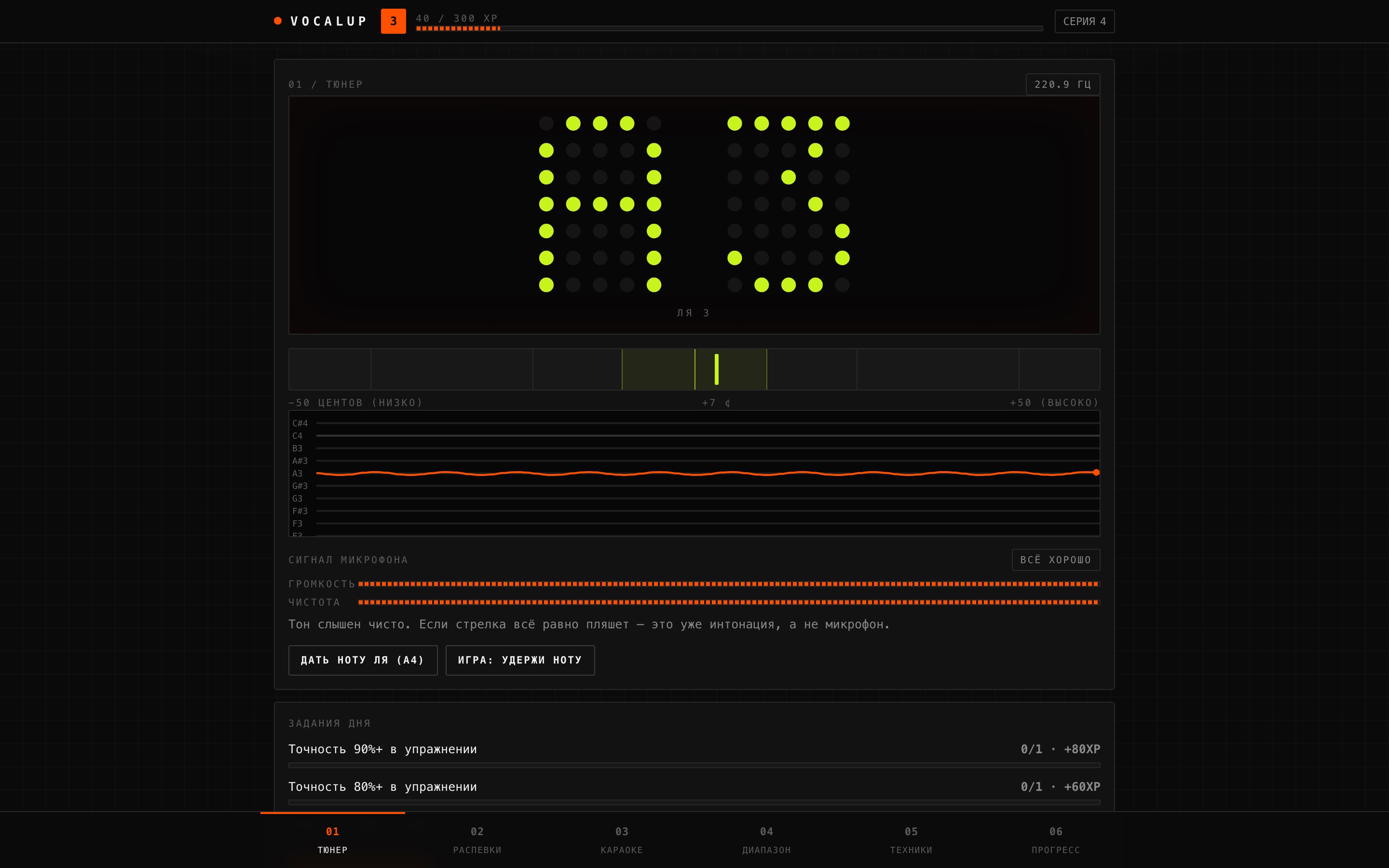
The live tuner: the note on a dot-matrix display, deviation in cents, a pitch trace with vibrato and the "Mic signal" panel.
02: Pitch Detection You Can Trust
Analysis runs in an AudioWorklet on the Essentia WASM core (PitchYin + probabilistic YIN), with a Viterbi pass over a 4-frame trajectory on top: a single octave glitch never reaches the screen, while vibrato and portamento pass freely. A fixed 94 measurements/s regardless of the main thread.
- Result on a synthetic voice: 1–3 cent error across E2–A5, no octave errors even with the fundamental suppressed.
- Silent fallback. If the Worklet or WASM is unavailable, a hand-written NSDF (McLeod) detector takes over — the user never notices.
- Three cascaded 85 Hz high-pass filters before the detector: mains hum and fans were killing detection outright.
- Adaptive silence threshold from non-tonal frames only. One-shot calibration got stuck at the ceiling if the mic was opened into noise, then cut off quiet singing.
03: Pedagogy Instead of a Timer
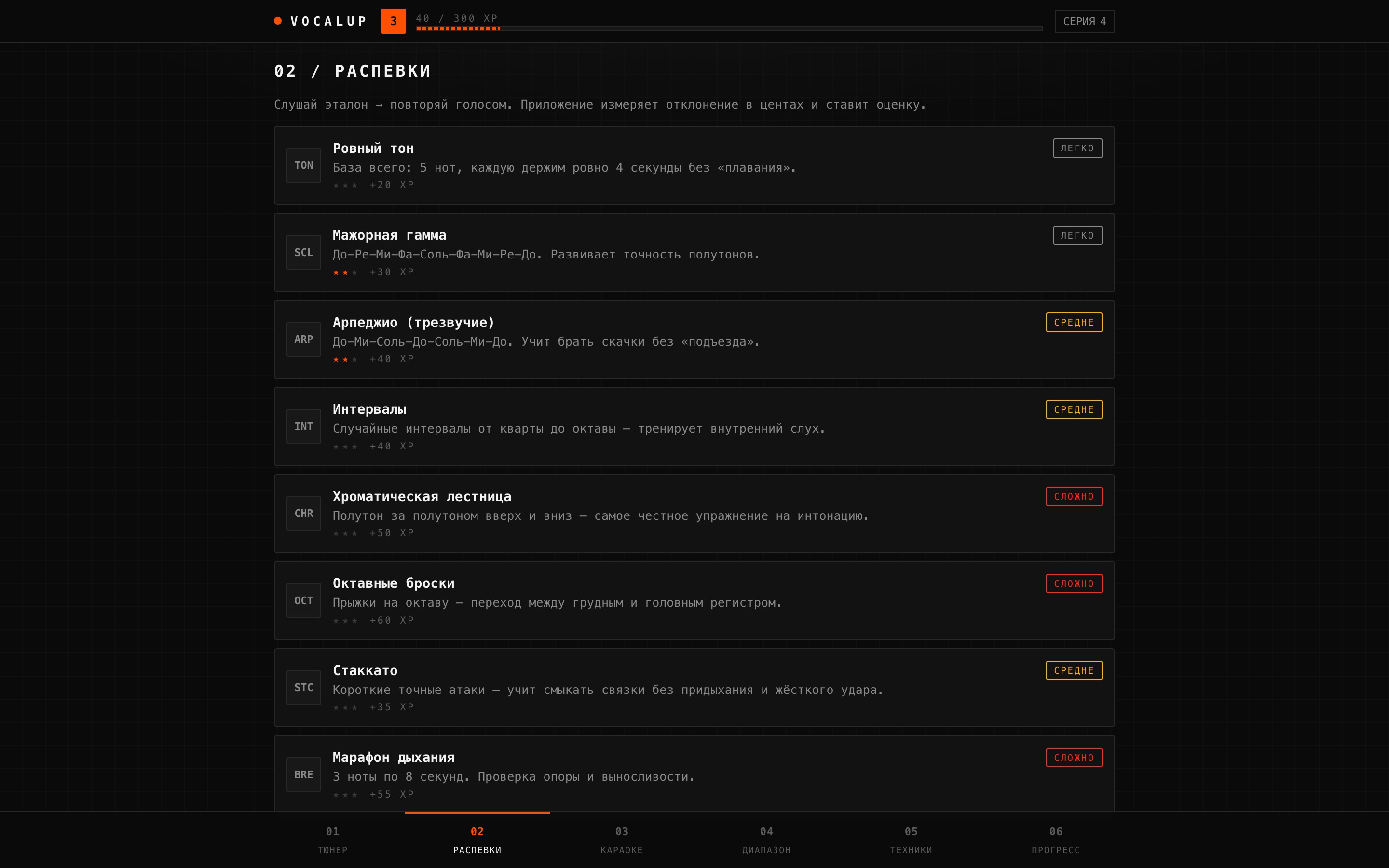
"Wait until I hit the note" mode. The note doesn't advance on a clock; it waits until the voice holds within ±35 cents for 0.6 s. A bar shows accumulated hold; on a slip it drains slower than it filled. Scoring uses only the held portion: the path to the note is searching, not singing, and penalising it is pointless.
const HOLD_TOL = 35;    // cents — half a semitone with margin
const HOLD_MS  = 600;   // how long to hold for the note to count

if(c!=null && Math.abs(c)<=HOLD_TOL) this.hold=Math.min(HOLD_MS, this.hold+dt);
else this.hold=Math.max(0, this.hold-dt*0.4);   // drain gentler than fill: a slip doesn't reset to zero